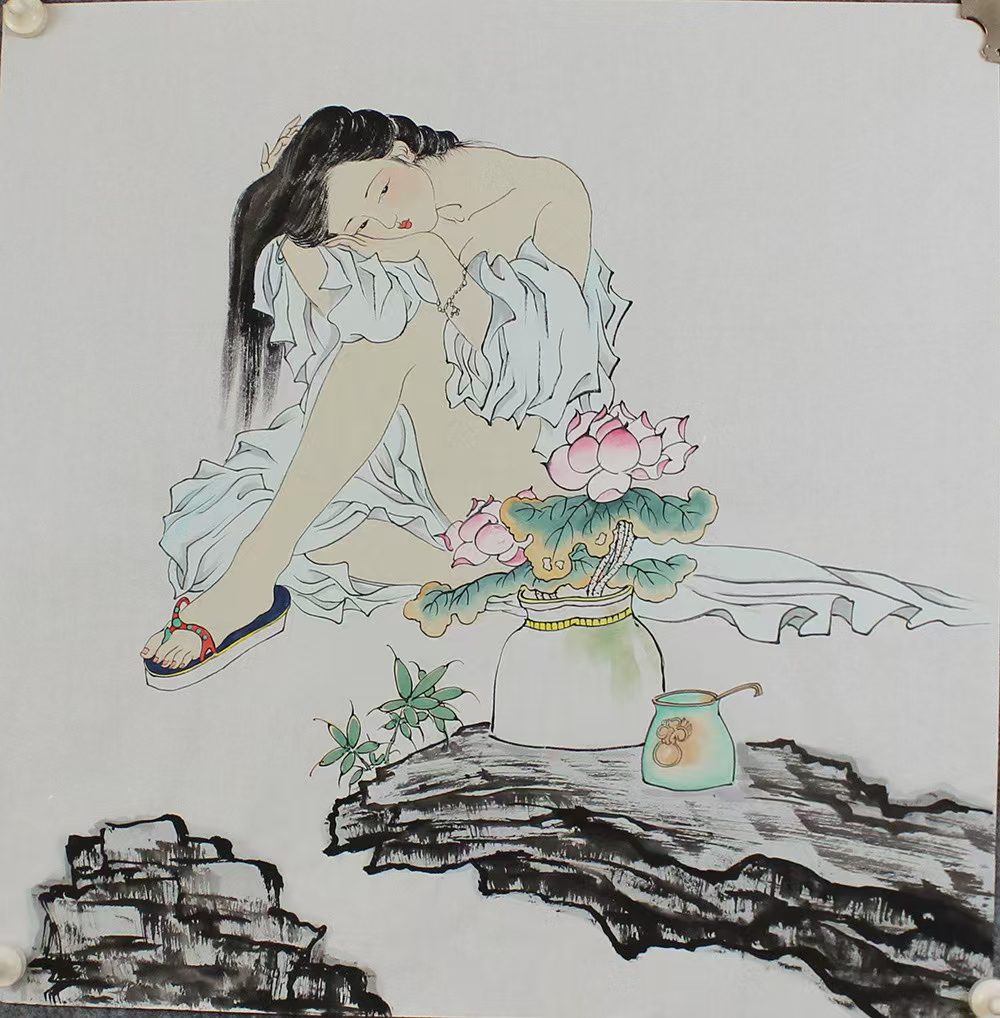
Modern Chinese painting stands for a lively and dynamic evolution of artistic expression that elaborately mixes standard techniques with modern motifs and styles. The roots of modern Chinese painting can be mapped back to the late Qing Dynasty, however it obtained substantial grip and international acknowledgment during the 20th century, especially after the facility of the People’s Republic of China in 1949.
One can not go over modern Chinese painting without recognizing the influence of the Chinese literati, or scholar-officials, that historically held a revered placement within Chinese culture. Their emphasis on personal expression, literary allusions, and the quest of imaginative integrity prepared for the modern musicians navigating the facility landscape of contemporary society. This long-lasting viewpoint ended up being specifically considerable as musicians looked for to insist their identifications in the middle of the fast innovation and globalization that identified late 20th-century China. With the lens of ink and brush, these creators started to express their feedbacks to the truths of life in a transforming world, resolving problems of identification, heritage, and the influence of political turmoil.
The evolution of modern Chinese painting can additionally be connected with the intro of Western art movements in the late 19th and early 20th centuries. Musicians like Xu Beihong championed the combination of Western strategies, such as oil painting, right into typical Chinese techniques. He supported for a hybrid design that preserved the essence of Chinese aesthetic appeals while embracing the realistic look and perspective offered by the Western canon. Such experimentation marked the start of an era where the lines in between typical Chinese painting and modern methods became significantly blurred, fostering an ambience of imagination and development.
The Cultural Revolution (1966-1976) brought around significant chaos and repression in the art globe, as the Chinese Communist Party looked for to regulate cultural expressions that did not straighten with its ideological framework. Their vibrant strategy encouraged arising musicians to discover unconventional styles, materials, and strategies, better pressing the limits of modern Chinese painting.
One noteworthy element of modern Chinese painting is its deep-rooted link to socio-political commentary. Musicians such as Ai Weiwei and Zhang Xiaogang have utilized their job to discuss pressing social problems, consisting of civils rights abuses, class struggles, and collective memory. Ai Weiwei, known for his provocative setups and theoretical artwork, mixes standard Chinese aesthetic appeals with modern methods to resolve themes of civil liberty and governmental authority. His jobs typically test visitors to face the intricacies of heritage and identity against the backdrop of a swiftly transforming society. Similarly, Zhang Xiaogang’s emotionally charged pictures record the nostalgia and trauma connected with China’s tumultuous past, showing a cumulative awareness that reverberates strongly with audiences both locally and worldwide.
The rise of woman musicians in modern Chinese painting has actually also played an essential duty in diversifying the artistic story. Artists like Liu Xiaodong and Yin Xiuzhen have discovered gender, identification, and social assumptions with their works, offering fresh viewpoints that challenge the mainly male-dominated art globe. Liu Xiaodong, renowned for his capability to capture the human condition via portrait, often portrays individuals from marginalized neighborhoods, highlighting the complex tapestry of modern life in China. On the various other hand, Yin Xiuzhen uses multimedias and setups to discover themes of globalization, consumerism, and the setting, showcasing the intersection of typical Contemporary concerns and chinese values. Their contributions have actually enhanced the landscape of modern Chinese painting, fostering an environment where diverse voices can be listened to and valued.
The global art market has actually significantly acknowledged modern Chinese painting, with public auction homes and galleries taking note of its climbing prestige. The global phase has actually supplied possibilities for Chinese artists to display their job past national borders, transforming the way art from China is regarded and valued.
In spite of these difficulties, modern Chinese painting continues to thrive, driven by a brand-new generation of musicians who are unafraid to press boundaries and challenge conventions. The integration of digital art, video installments, and efficiency art shows the fluidity of contemporary Chinese identification, mirroring the fast pace of social change and the intricacies of modern existence.
As we delve much deeper into the world of modern Chinese painting, it ends up being obvious that it is a representation of both collective and individual experiences. Modern Chinese painting serves as a mirror showing the stories of its individuals, capturing the contradictions, desires, and wonders of contemporary culture.
The proceeding dialogue between practice and modernity stays a defining feature of modern Chinese painting. While the exploration of brand-new techniques and designs is extremely important, many musicians remain rooted in classical practices, guaranteeing that the essence of Chinese cultural heritage persists in their work.
As musicians share experiences and concepts, they develop brand-new stories enhanced by diverse perspectives, enabling modern Chinese painting to progress continuously. This joint spirit advertises a wider understanding of modern Chinese art as an interconnected international discussion instead than a singular, isolated phenomenon.
Ultimately, modern Chinese painting is characterized by its capability to encapsulate a large range of intellectual and psychological responses to contemporary life. As artists engage and face with the obstacles of globalization, innovation, and social adjustment, they supply powerful understandings into the human problem. From emotional representations on history to enthusiastic visions of the future, the stories woven right into modern Chinese painting welcome us to consider our common humankind, going beyond social obstacles and attaching us in profound ways. As we navigate a significantly complicated globe, these imaginative expressions remind us of the importance of compassion, understanding, and the power of visual narration fit our cumulative awareness. Hence, modern Chinese painting stands not simply as a testament to artistic testing yet as an important social dialogue that connects the past, present, and future, guaranteeing that the tales of its individuals proceed to resonate and motivate.
Discover Modern Chinese Painting the vibrant evolution of modern Chinese painting, where conventional strategies meet modern styles, reflecting cumulative and personal stories formed by history, politics, and cultural identity.